Virtual Safety Car
VSC
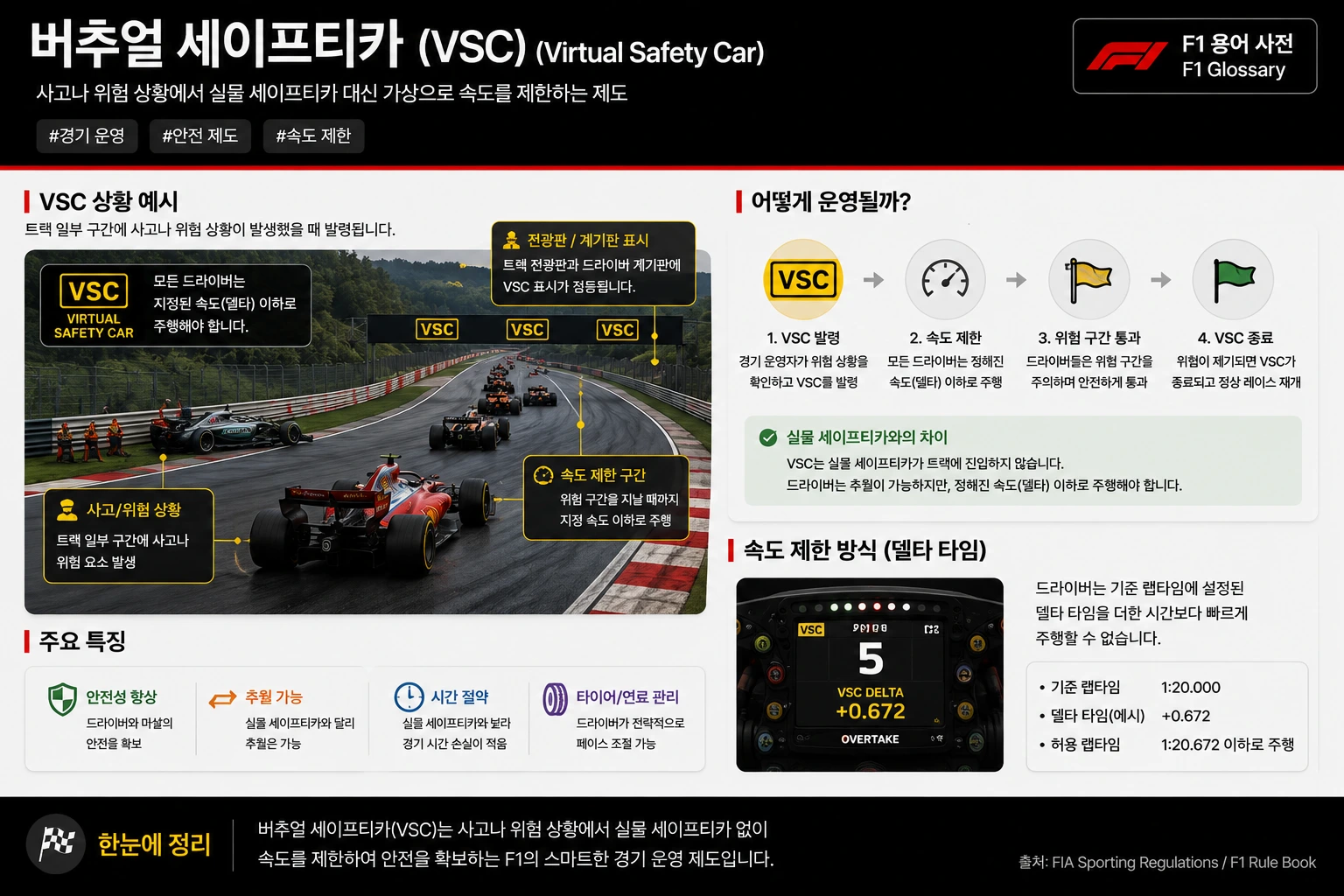
It is a system used to enforce a speed limit on all cars instead of deploying an actual safety car when a hazardous situation occurs on the track. Drivers must slow down and adhere to the delta time displayed on their steering wheel.
🏆 Race Case Study
Why the VSC is an Ideal Opportunity for a Pit Stop
When a Virtual Safety Car (VSC) is deployed, all drivers must drive slower than usual, adhering to a delta time. During this period, the time spent in the pit lane does not change significantly, reducing the relative time lost in a pit stop compared to normal race conditions. Consequently, teams immediately consider whether to change tires when a VSC is deployed, as the timing can have a significant impact on position battles.
📺 Race Context & Viewing Tips
Frequently asked questions
Can drivers overtake during a VSC period?
As a general rule, overtaking is prohibited while the VSC is active. All drivers must follow the required delta time, and position-changing overtakes are not allowed except in certain exceptional situations.
What is the difference between VSC and the Safety Car?
Under VSC, no physical safety car enters the track and every driver slows down according to a prescribed delta time. Under the Safety Car, an actual car leads the field and the F1 cars bunch up behind it, significantly reducing the gaps between them.
🔎 Looking for another F1 term?