Visible wings
- Front wing
- Rear Wing
01 · F1 GUIDE
From the front wing to the power unit
F1 Car Anatomy — the key parts that make up a Formula 1 car and how they connect with each other.
Click a pin to see where each part sits on the car and what it does in one line.
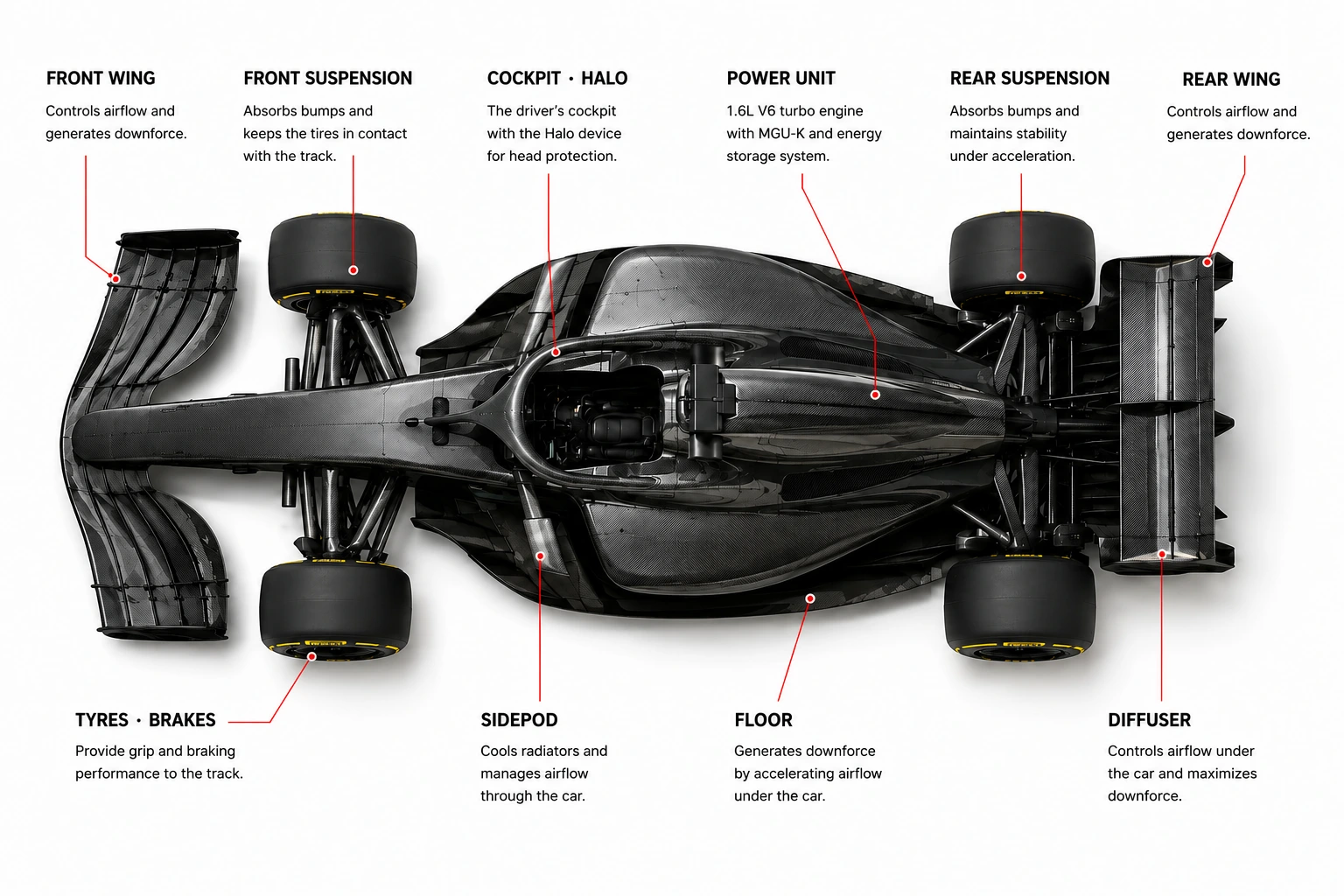
This section shows where parts are. What each system does and how they connect is explained below.
Five systems, working together, in about 30 seconds.
Cornering faster by using the air around the car.
An F1 car's downforce is not only made by the wings you can see. In the current ground-effect era, the parts underneath the car matter just as much.
These parts are not independent. Air disturbed at the front wing keeps travelling down the car, so what happens at the front affects how well the floor and rear wing work behind it.
Downforce itself is explained in more detail on its own term page.
F1 is not driven by the engine alone.
A modern F1 power unit is one system with several parts: the combustion engine, a turbocharger, the MGU-K electric motor and the energy store that supplies it.
For how MGU-K and the rest of the power unit work in detail, see its own term page.
In the end, every force reaches the ground through four tyres.
Acceleration, braking and cornering all ultimately happen between the tyre and the road surface.
Suspension is not only about ride comfort. It is a system that manages several jobs at once.
Tyre compounds and pit stop strategy are covered in more depth in the tyre guide.
A fast car also has to stop well.
Braking in F1 is not only mechanical friction from the discs. It is also linked to the energy recovery system at the rear.
When slowing down, some of that energy is captured and stored rather than being lost as heat.
The survival structure that surrounds the driver.
It is not just the halo. Several parts together form a single safety system around the driver.
The halo protects the head from debris and side impacts, but the survival cell, harness, seat and headrest work together with it in a crash.
How the parts above connect to what actually happens in a race.
Since the 2022 regulations reintroduced ground effect, the floor and its venturi tunnels generate a large share of an F1 car's total downforce, often more than the front and rear wings combined. Even damage that looks minor underneath the car can change how the airflow behaves and cost real lap time.
Not quite. The engine (ICE) is only the 1.6-litre V6 turbo combustion unit. The power unit is the complete system that also includes the MGU-K electric motor, the energy store (battery) and the control electronics that manage how combustion and electrical power work together.
Yes, every F1 car has a suspension system, but it is tuned very differently from a road car. It is extremely stiff to keep the aerodynamic platform stable and to feed load into the tyres consistently, rather than to maximise ride comfort.
The front and rear wings redirect airflow to push the car down onto the track, creating downforce. That extra downward force lets the tyres grip harder in corners, so the car can carry more speed through a bend without sliding.
The technical regulations set boundaries, not a single fixed shape. Inside those limits, teams interpret bodywork, sidepod and floor design differently to chase their own balance of downforce, drag and cooling, which is why cars built to the same rules can still look noticeably different.
Terms that come up whenever an F1 car's structure is being discussed.
Component roles and 2026 power unit changes are summarised from the FIA Formula One Technical Regulations. Summarised for readers rather than quoted, and detailed dimensions or numeric limits are deliberately left out. Always treat the published regulations as the authority.